Friday, January 10, 2020

Performance Management in an organization

Performance Management in an organization


Introduction
Performance management is a process used to improve the performance of teams and organizations and is a systematic process to improve the performance of individuals, teams and the performance of organizations. Strategic Performance Management focuses on what needs to be done to help the company achieve its business objectives. Performance management systems are generally considered for individuals and very limited groups. This can sometimes be seen as a matter for individuals and their managers, but performance management processes must be applied to teams and organizations.


Managing organizational performance is one of the key responsibilities of top management and provides leadership in planning, organizing, monitoring, managing and achieving strategic objectives and meeting needs and requirements.


Role of Performance Management -

Performance management is an important part of the work that is led by HR managers or business management. This business discipline is there to ensure that the performance of employees is in line with the objectives of the company and that employees achieve these objectives. Performance management plays an important role in increasing business value.


The purpose of managing business performance is to improve the efficiency of an organization - the ability of an organization to function effectively. It is about the ability of a company to guarantee high performance, achieve its objectives and above all to meet the needs of its stakeholders.


The most important long-term goal of corporate performance management is to promote a culture of high performance and to increase the efficiency of the organization - the ability of an organization to function effectively


An efficiently implemented performance management system can benefit various systems, managers and employees:

Organization’s Benefits
Improved organizational performance, employees retention and loyalty, improved productivity, overcoming the barriers to communication, clear accountability and cost advantages  
Manager’s Benefit
Saves time and reduces conflicts, ensures efficiency and consistency in performance
Employee’s Benefits
Clarifies expectation of the employees, self-assessment opportunities clarifies the job accountability and contributes to improved performance, clearly defines career paths and promotes job satisfaction  

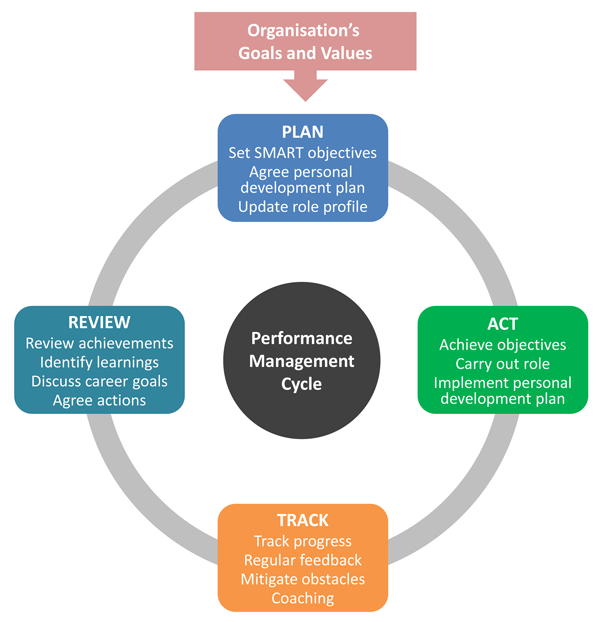
Performance Management as a Cycle-


Picture 01, Performance Management as a Cycle

Objectives of Performance Management -

01.Employees are able to achieve high performance standards and work performance

02.Improving employee efficiency by encouraging, motivating and implementing a profitable pay mechanism

03.Helping employees to identify the knowledge and skills needed to perform the task, allowing them to focus on the right work.

04.Identifying berries and overcoming these barriers through monitoring, training and development interventions

05. Set a basis for strategic planning, succession planning, promotions and performance-based payments for multiple management decisions.

conclusion-
Performance management is one of the most important considerations for corporate management and active employee engagement. A good performance management system works to improve the overall performance of the organization by managing the performance of teams and individuals to ensure the overall goals and objectives of the organization are achieved. An effective performance management system can play an important role in managing an organization's performance.

References/ Bibliography-
Armstrong, M. and Stephen Taylor (2014) Armstrong Handbook of Human Resource management practice, 13th edition.
Armstrong, M and Baron, A (1998) performance Management: the new realities, London.
Bourne, M, Franco, M, and Wilkes, J (2003) Corporate performance management, Measuring Business Excellence.

How effect organizational culture on Employee performance


How effect organizational culture on Employee performance


Definition for Organizational Culture-
Organizational culture defines the way employees complete task and interact with each other in an organization. The culture paradigm comprises various belief, valves, and symbols that govern the operating style of the people within a company. Corporate culture binds the workforce together and provides a direction for the company in times of change, the biggest challenge for any organization may be change its culture, as the employees are already accustomed to a certain way of doing things.   

Organizational or corporate culture is the patters of values, norms, belief, attitudes and assumptions that may not have been articulated but shape the ways in which people in organization behave and things get down. ‘Valves’ refer to what is believed to be important about how people and organization behave. ‘Norms’ are the unwritten rules of behaviors.
This definition emphasizes that organizational culture is concerned with the subjective aspect of what goes on in organizations.

The component of Organization culture-
Organizational culture can be described in term of Values, norms, artefacts, and management or leadership styles

Types of the Organization cultures-
The dominant culture in organizations dependents on the environment in which the company operates, the organizational objectives, the belief system of the employees and the company’s management style. Therefore there are many organizational cultures. For examples well-structured organizations typically follow a culture with extensive controls. Employees follow standards procedures with strictly defined individual roles and responsibilities. Those in competitive environments, such as sales, may forgo strict hierarchies and follow a competitive culture where the focus is on maintaining strong relationship with external parties.    

Advantages of the organization culture-
Strong cooperate culture indicate that employees are like-minded and hold similar belief and ethical values. When these belief and ethical values align with business objectives, they can prove to be effect in building teams because rapport and trust quickly ensue. The bonds that the teams build help them avoid conflict and focus on task completion. Strong cooperate culture ease communication of roles and responsibilities to all individuals. Employees know what is expected of them. How management assess their performance and what forms rewards are available.

How to effect culture on employee performance-
Organizational culture can have varying impact on employee performance and motivation levels. Oftentimes employee work harder to achieve organizational goals if they consider themselves to be part of corporate environment. Different culture operating in one company can also impact employee performance. For examples the organization maintain a reserved  “talk when necessary’’ culture, employees may work accordingly, however if the organization allows one area, say the sales team, to be outspoken and socially active, the organization may experiences rivalries among areas, thus allowing an area to set up their own culture can affect the performance of the employees deployed in the country.


Picture 01, How to affect organizational culture on Employee performance.

Combining performance and culture-

The company must transform its recruitment process to attract and engage the same beliefs and values that are central to the organization. This reinforces corporate culture by ensuring that the new employee joins the company. Organizations must ensure that the corporate culture aligns with the performance management system. When cultural and management systems are not applicable. Management must redirect employees' behavior to achieve organizational goals.

References/ Bibliography-
Armstrong, M. and Stephen Taylor (2014) Armstrong Handbook of Human Resource management practice, 13th edition
Argyle, M (1989) The Social psychology of work, Harmondsworth, Penguin
Denison, D, R (1996) what is Different between organization culture and organization climate.

Wednesday, December 4, 2019

The concept of employee Engagement


The concept of employee Engagement


Introduction-

The concept of employee engagement is often defined as a willingness to go the extra mile, which has become the new engagement mantra. Sometimes this is defined by the concept of engagement in many ways. It is often used as a concept adopted by the company in terms of job performance, enterprise citizenship and commitment to its employees' participation and behavior.

Why does the ambiguity of the word make it difficult to answer the question of engagement? Are employees involved with their jobs, their carrier or their company, Some definitions avoid this distinction by referring to engagement only as a condition for people to do it. Others define it with the purpose and values ​​of the organization. Engagement occurs when people commit to their work and organization and are motivated to achieve high-quality work and high-quality work. It has two interconnected features.

First: Employee engagement occurs when employees try to be comfortable, because they find their work interesting.

Secondly, they believe that this is a great place to work, to pursue and maintain organizational engagement, their work values ​​and purpose. Finally we define an employee engagement as the property of the relationship between an organization and its employee and the ‘engaged employee’ is defined as a person who is fully internalized by their work and therefore takes positive action to further the company’s reputation and interests.


Picture 01, what is employee engagement.

Why is employment engagement important-
Engaged employees are the backbone of good work environments, where people are hardworking, ethical and accountable, and engagement levels vary according to different life history and personality traits. When it comes to company performance, success is measured by the quality of the customer experience and customer loyalty. Engagement is shown to be delivered by the employee, which benefits the organization through commitment


Picture 02, The process of Employee Engagement.

Outcomes  of employee engagement :
Organizational outcomes
Employee outcomes
Employee engagement is a hard-nosed proposition that not only shows result but can be measure in costs of recruitment and employee output

Engagement offer a solution for the individual providing them with the opportunity to invest themselves in their work

Engaged employees are more likely to stay with the organization perform better than their colleagues and act as advocates for the company/ organization
Engagement may result in positive health effects and positive feelings towards work and the organization
For the Successful organization changes
Transnational approach to the relationship between employer and employee

Facets of Employee engagement-
01. Intellectual Engagement- Thinking hard about the job and how to do it better
02. Affective engagement- Feeling positively about doing a good gob than others for the organizational and self-development
03. Social engagement- Actively taking opportunities to discuss work- related improvements with others at work

References-
Armstrong, M. and Stephen Taylor (2014) Armstrong Handbook of Human Resource management practice, 13th edition
Armstrong, M, Brown, D and Reilly, P (2010) evidence-based Reward Management, London, Kogan page

Knowledge management for an organization


Knowledge management for an organization


INTRODUCTION:

Knowledge management is a broad process of identifying, managing, modifying and using information and expertise within an organization. The overall knowledge management process is supported by four key functions, such as leadership, culture, technology and measurement. Knowledge Management stores and shares knowledge, understanding and expertise gathered in an organization with its processes, methods and activities. It is an important source of knowledge. As Ulrich (1998: 126) has noted, knowledge has become a direct competitive advantage for firms that sell knowledge and ideas.

Knowledge management is of great concern to people and how they acquire, exchange and disseminate knowledge about information technology. It therefore becomes an important area for the HR practitioner who is in a strong position to influence this aspect of public management. It is linked to organizational learning.

Knowledge Management Definition:

Knowledge management is about gaining knowledge from those who need to increase the performance of the organization. Knowledge management strategies encourage people to share knowledge by connecting with people and sharing information so that they learn from documented experiences.

Knowledge Management Scarborough et al (1999) defined: 'To create knowledge, make, and capture, share and use, where, they propose organizational knowledge and processes as a result of organizational learning and the development of COL in organizations to improve the performance of any process. Knowledge management is concerned with the flow of both stocks and knowledge.


Picture 02, Benefits of knowledge Management

The objectives of knowledge management-

Key objectives of knowledge management are

01. Enhance / Improve Internal Cooperation between Employer and Employee and Improve Cooperation between Employees

02. Enhance / Improve External Support

03. Catch / record / share best practices

04. Improve customer relationships and its management

05. Create better project work-spaces and their management

06. Improving documents and protecting proprietary materials

07. A smooth transition from retirees to recruiting heirs to fill their posts

08. Reduce corporation memory loss and rest

09. Identify the most important source of knowledge and the most important fields, so that the organization

10. Develop a toolkit of methods that individuals, groups and organizations can use to mitigate the potential loss of capital

Knowledge management strategies-
There are two strategies/ two approach have been identified by Hansen et al (1999): the codification strategy and the personalization strategy

The Codification strategy:
‘Knowledge is carefully codified and stored in database where it can be accessed and used easily by anyone in the organization. Knowledge is explicit and its codified using a ‘people-to-document’ approach. This strategy is therefore document driven’

The Personalization strategy:
Knowledge is closely tied to the person who has developed it and is shared mainly through direct person-to person contract. This is a ‘person-to- person approach that involves ensuring that tacit knowledge is passed on. The exchange is achieved by creating networks and encouraging face-to-face communication between individual and terms by means of informal conference, workshops, communities of practice, brainstorming and one-to-one sessions


Conclusion-
Knowledge management is about gaining knowledge from those who need to increase the performance of the organization. Without a firm for knowledge management in an organization it can slow down the progress of the organization. So this concept is very important to improve the best work environment in the organization.

References-
Armstrong, M. and Stephen Taylor (2014) Armstrong Handbook of Human Resource management practice, 13th edition
Boxall, P and Purcell, J (2000) strategic human resource management
Mecklenberg, S, Deering, A and Sharp, D (1999) Knowledge management


Sunday, November 17, 2019

Employee relations


Employee relations


Introduction:

Employee relation are concerned with managing the employment relationship and the psychological contract. They consist of the approaches and methods adopted by employer to deal with employee either collectively through their trade unions or individually. This includes providing employees with a voice and developing communications between them and management. An organization with a good employee relations program provides fair and consistent treatments to all employee.

Employee relations program are typically part of a human resource strategy designed to ensure the most effective use of people to accomplish the organization’s mission. Employee relations programs focus on issues affecting employees, such as pay and benefits, supporting work- life balance and safe working environment.

The process of Employee relations

Employee relations are concerned with managing and maintaining the employment relationship taking into account the implications of the notion of the psychological contract. This means dealing with employees either collectively through their trade unisons or individually, handling employment practices, terms and conditions of employment and issues arising from employment, providing employees with a voice and communicating with employees.

One of most effective ways for a organization to ensure good employee relation is to adopt a human resource strategy that places a high value on employees as stakeholder in the business. When employees are treated as more than just paid laborer, but as actual stakeholder with the power to affect outcomes, they feel more valued for the job they do.

Today in the world most of companies, organizations, are practicing ‘employee relation’ as proper way to develop the overall objectives of the companies and same time of the employees. By today most of the companies have given the special attention to the following labor priorities to make sure good employee relations.

01. Respect for the employees
02. Offer competitive wages and benefits
03. Treat every employee with dignity and without any tolerance
04. To assure a safe and healthy working environment for the employees


Picture 01, Key dimensions of employment relation

The main objectives and the important of the employee relations for the company as following:

01. To develop and maintain harmonious relations between management and labor so essential foe higher productivity of labor and industrial progress in the company

02. To safeguard the interest of labors as well as management by securing the highest level of mutual understanding between all sections in the company

03. To establish and maintain industrial democracy based on the participation of labor in the management and gain of industry.

04. To avoid all forms of industrial conflict so as to ensure industrial peace by providing better working and living standards to worker

05. To raise productivity in an era of full employment by reducing the tendency of higher turnover

06. To ensure a healthy and balanced social order through recognition of human in industry and adaptation of social responsibilities to the advancement of technology

Conclusion:

The most important part is no business can run effectually without the employees or people. Employer need to manage relationship in the workplace to keep the business functioning smoothly, avoid the problems, and make sure the employees are performing at their best. So without the good relationship between the employee and employer there will be big issues.   


Friday, November 15, 2019

Talent Management


Talent Management


What is the Talent?
Talent is what people have when they possess the skill, abilities and that enable them to perform effectively in their roles. They make a difference to organizational performance through their immediate effort and they have a potential to make an important contribution in the future. Talent management mainly aims to identify, obtain, keep and develop those talented people for the organizational development

Talent Management is the Development of ensuring that the organizations has the talented people it needs to accomplish its business goals. It involves the strategic management of the flow of talent through an organization by creating and maintaining a talent pipeline.

Talent management is a useful term when it describe as organization’s commitment to hire, manage, develop and retained employees. It comprises of all the work process and systems that are related to retaining and developing a superior workforce

Talent management is a business strategy that organization will enable to retain their top talented employees. Just like employee involvement or employee recognition. It is the status business strategy that will ensure the attraction of talent with competition with other employees.

When you tell a prospective employee that you are dedicated to a talent management strategy that will ensure that he or she will have the opportunity to develop professionally, you attract the best talent

Basic content of the Talent Management
01.Talent planning
     02.Resourcing
     03.Attraction and retention policies and programme
     04.Talent audit
     05. Role Development
     06.Talent relationship management
     07. Performance management
     08.Learning and development
     09.Leadership and management development
     10.Management succession planning
     11.Carrier management


     Picture 01, process of Talent Management 
Different peoples who have different type of talents. But there is the view that we must pay more attention to the best, while on the other, the view is that everyone has talent and it is not just about the favorite few.

Key objectives of the Talent Management
   01.Identify the key gaps between the talent in place and the talent to drive business/ company success
    02.Develop a sound integrated talent management plan designed to close the talent gaps
  03.Facilitate and support management to implement accurate hiring and promotion decisions
   04.Develop talent to enhance performance in current position as well as readiness for transition to the next level
    05.Develop a succession and retention plan a sustain organizational excellence
  
     Conclusion
Talent management is a very important thing to getting the best of all employees for the organizational development. Also it helps to deliver corporate objectives and plan towards success of the company. On one hand talent management important to build up the productive and committed working environment for the people in the organization with succession planning for the future development and on the other hand it will helps to develop good leaders and good managers for the tomorrow  

References:
Armstrong, M. and Stephen Taylor (2014) Armstrong Handbook of Human Resource management practice, 13th edition

Clarke, R and Winkler, V (2006) Reflection on Talent Management, London, CIPD